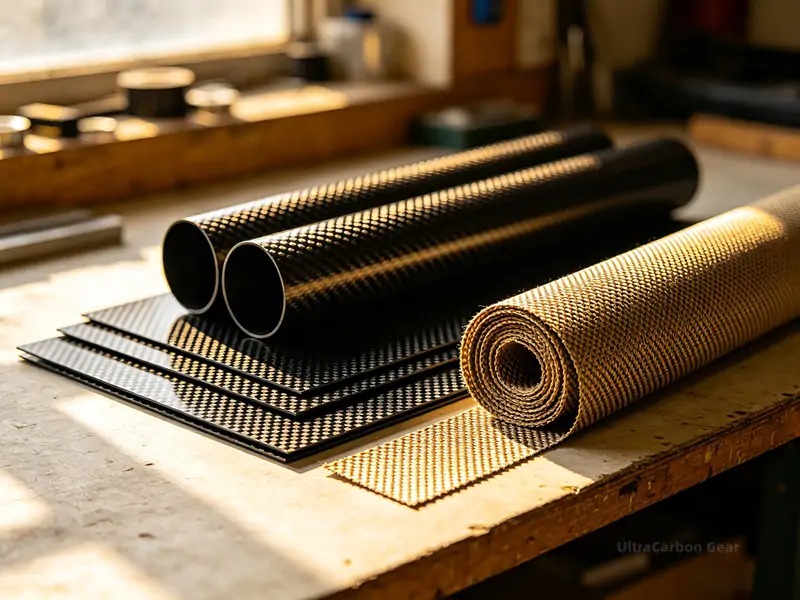
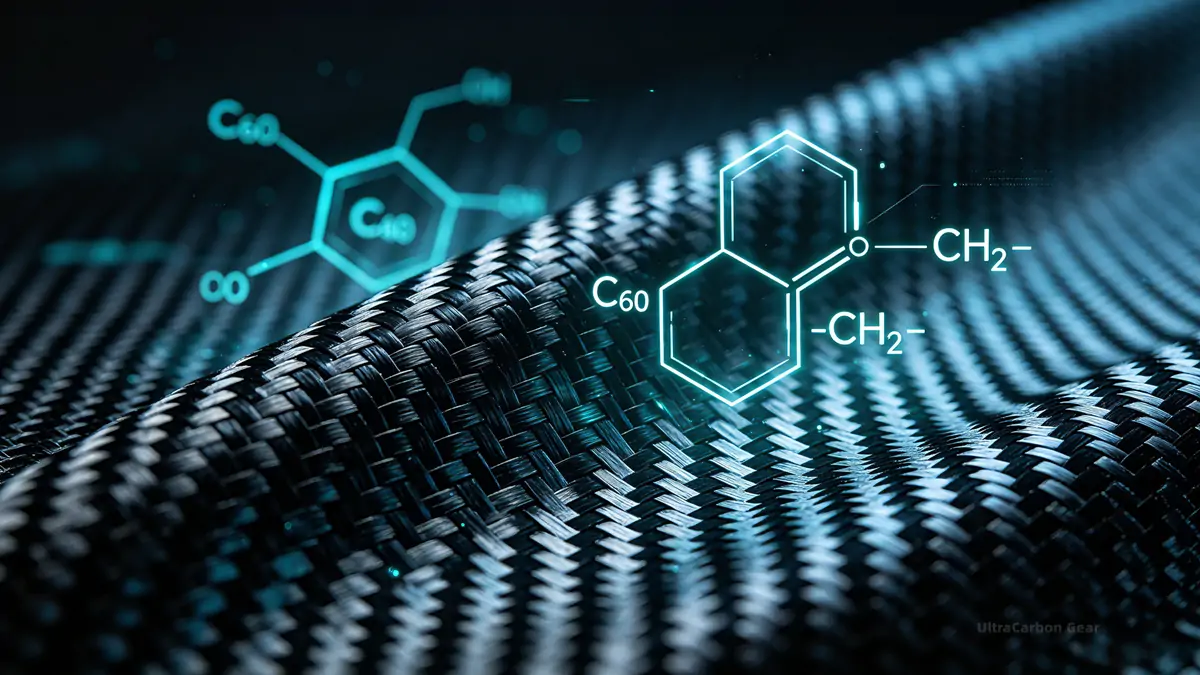
Hey friend—let's talk about something crazy. You know those sleek, black woven sheets of carbon fiber that make race cars, drones, and premium phone cases look so high-tech? Ever stopped to wonder what exactly that stuff is made of?
I'm not talking about the weave pattern or the shiny epoxy coat. I mean chemically—right down to the atoms. Because once you understand the hidden chemistry, you'll never look at a carbon fiber part the same way again. And more importantly, you'll know exactly which type to buy for your next project.
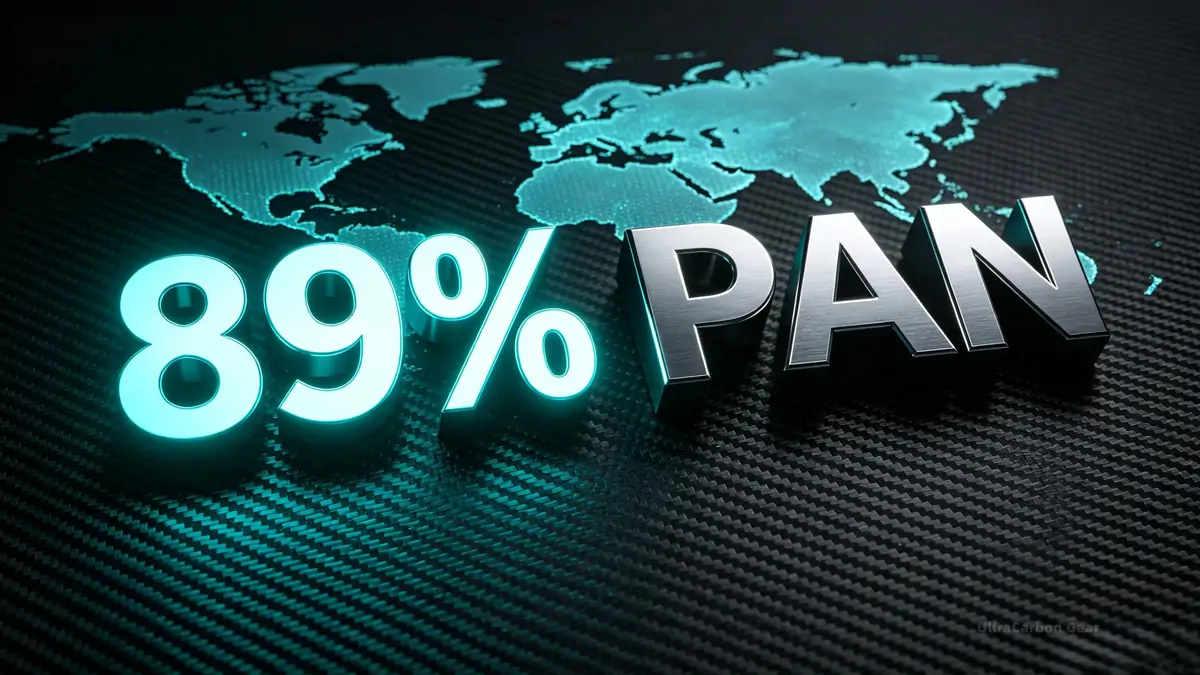
Here's the secret: almost all the carbon fiber products regular folks like us want—the strong, light, gorgeous parts we actually use—are made from a material whose story begins in a fluffy, white, acrylic-like fiber. That's PAN based carbon fiber. There's also another type, pitch based carbon fiber, which comes from coal tar or petroleum residue. Both are carbon fiber, but their chemical personalities are worlds apart.
Let's break it down like I'm sitting across a coffee table from you.
What Is Carbon Fiber, Chemically Speaking? The Atomic Truth
If you stripped away the marketing jargon, carbon fiber is deceptively simple: it's a filament composed of at least 92% carbon atoms. In high-modulus grades, that number climbs past 99%. These carbon atoms aren't randomly scattered. They're bonded together in tiny, hexagonal, chicken-wire-like sheets—exactly like graphite.
But here's the magic: in carbon fiber, those microscopic graphite sheets are locked into a long, fibrous crystal structure that's aligned along the axis of the fiber. Imagine microscopic decks of cards all lined up end-to-end. That directional alignment is what gives carbon fiber its jaw-dropping tensile strength—and why a strip of it can hold up a sports car but flop like a noodle if you bend it sideways.
Still, you can't just mine carbon fiber from the ground. You have to grow it from a precursor. And the precursor's chemical backbone determines everything: strength, stiffness, price, and what the fiber is actually good for. That's where PAN and pitch come in.
PAN Based Carbon Fiber: From Sweater Material to Superhero
The carbon fiber we sell, and the kind you'll find in the world's best consumer products, starts its life as polyacrylonitrile—or PAN for short. And yes, it's basically the same polymer family used to make acrylic knitwear. Crazy, right?
What is PAN based carbon fiber made of, chemically?
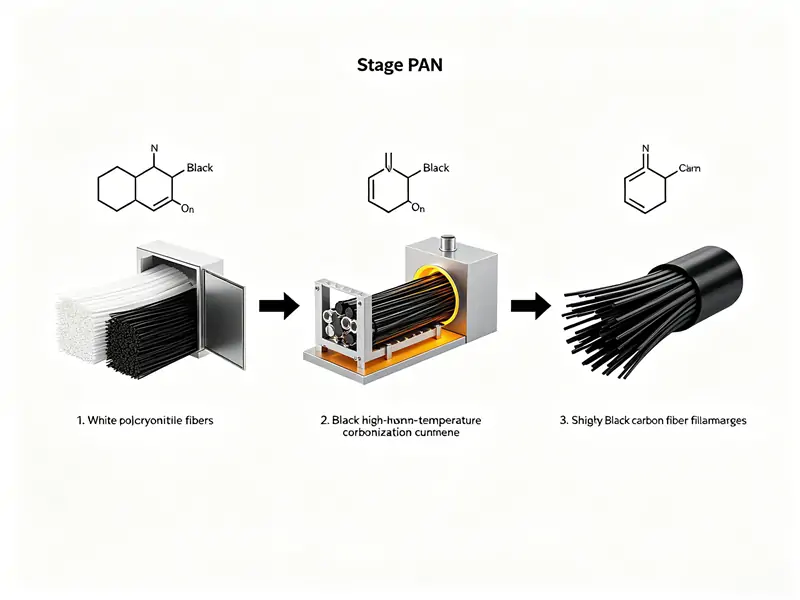
Pure PAN is a chain of molecules built around carbon, hydrogen, and nitrogen atoms – (C₃H₃N)n. On its own, that plastic thread isn't strong enough for a wristwatch strap. But when you carefully cook it in a specific oxygen-rich environment, something profound happens.
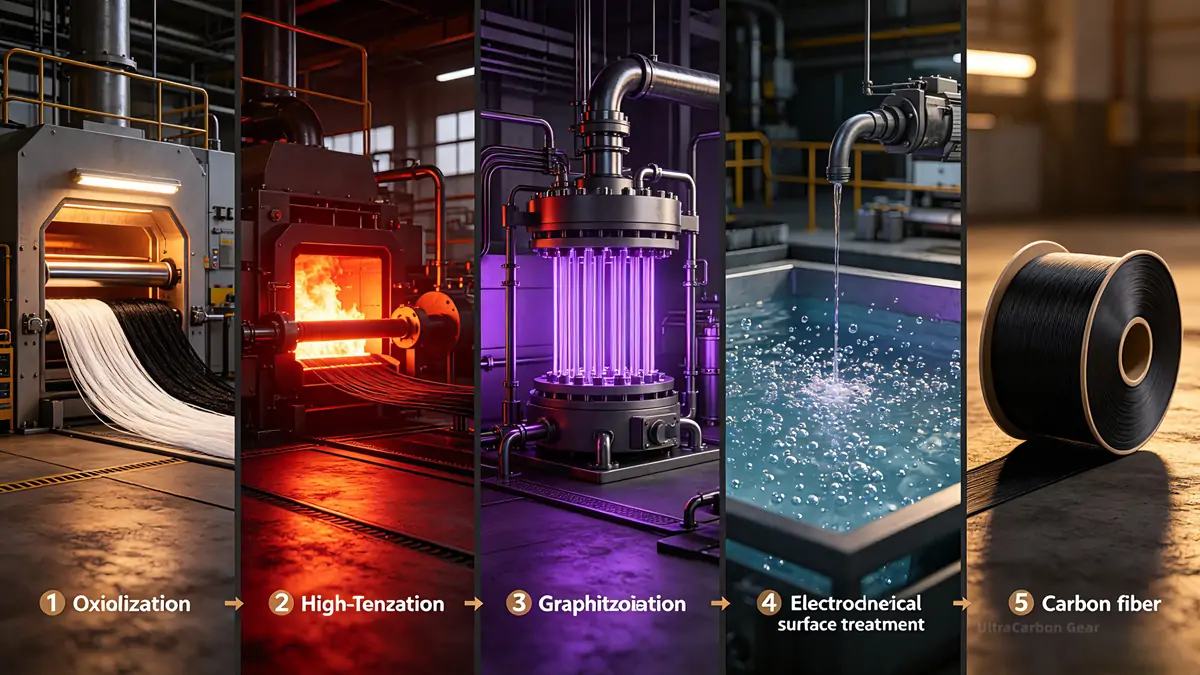
First, the PAN fibers are heated to around 200–300°C in air. The polymer chains don't melt; instead, they undergo cyclization and dehydrogenation. Those nitrogen atoms help form incredibly stable, ladder-like ring structures, turning the fiber from white to an infusible, black oxidized state. Think of it as pre-tensioning a molecular net.
Next comes carbonization: the fiber is pulled through furnaces at 1,000–1,500°C in an atmosphere without oxygen. Here, nearly every non-carbon atom—hydrogen, nitrogen, oxygen—is stripped away as gas. What remains is a pure, tightly packed carbon skeleton. The hexagonal graphite layers try to form but are kept slightly turbostratic (meaning they don't perfectly stack like pencil graphite). That imperfection is actually a gift: it stops cracks from zipping across the fiber, giving PAN based carbon fiber its legendary tensile strength. For super-stiff grades, an optional graphitization step at 2,000–3,000°C fine-tunes the crystal lattice.
Long-tail answers woven right in:
- How is carbon fiber made from polyacrylonitrile? – Through a three-step thermal drama: oxidation, carbonization, and surface treatment that bonds the fiber with epoxy resin.
- Why is carbon fiber so strong if it's just plastic? – Because it's not plastic anymore. After carbonization, it's almost entirely pure carbon, with a molecular alignment so directional it rivals the strongest materials on Earth.
This is exactly why the carbon fiber plates, tubes, and cloth in our store are exclusively PAN based. The chemistry translates directly into parts that are superhumanly strong for their weight, absorb impacts without shattering, and bond beautifully with the epoxies you use in your DIY and professional builds.
Pitch Based Carbon Fiber: When Stiffness Is Everything
Now, let's talk about the specialist. Pitch based carbon fiber comes from a completely different family tree. Its precursor is a pitch—either petroleum pitch (a heavy residue from oil refining) or coal-tar pitch. And its chemistry is fundamentally about big, flat, aromatic hydrocarbon molecules.
What's the chemical story of pitch based carbon fiber?
The raw pitch is a soup of polycyclic aromatic hydrocarbons—multiringed, flat molecules that look like molecular pancakes. Through a process called mesophase formation, these disk-like molecules naturally assemble into a liquid crystal state, aligning almost perfectly parallel to one another. When you spin this mesophase pitch into fibers and then carbonize it at ultra-high temperatures, those pre-aligned aromatic layers convert into graphite crystals with near-perfect stacking.
The result is an extremely high-modulus fiber. Chemically, it can easily exceed 99% carbon content, and those aligned crystals give it stiffness that PAN based fibers can only dream of. But there's a trade-off: the highly ordered graphitic structure is more prone to micro-cracking and has lower tensile strength. It's a brittle, ultra-stiff marvel.
This is why you'll see pitch based carbon fiber used for satellite structures, precision optical benches, and industrial rollers where dimensional stability under temperature changes is more important than surviving a hard knock. It's not the material you'd choose for a crash-resistant drone frame or a flexible automotive splitter.
- When should you use pitch based carbon fiber? – When you need maximum rigidity, minimal thermal expansion, and are willing to sacrifice impact toughness.
- Is pitch carbon fiber cheaper? – Not necessarily. Its processing is complex, and it's produced in lower volumes, making it expensive and niche.
For 99% of enthusiast, automotive, sports, and DIY applications, PAN based carbon fiber is the smarter, stronger, and more versatile choice.
PAN vs Pitch Carbon Fiber: The Chemistry-Driven Comparison
Let's put it side-by-side, based purely on what their atoms are doing.
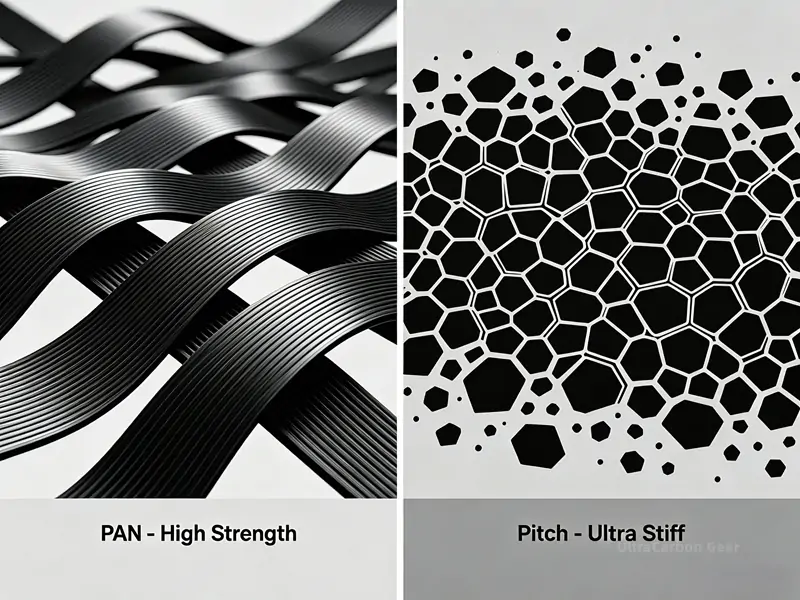
Tensile Strength: PAN dominates. Its turbostratic carbon structure absorbs energy and resists crack propagation. This is the fiber that lets you flex a carbon fiber plate without it snapping.
Modulus of Elasticity (Stiffness): Pitch wins on paper. Perfectly stacked graphite layers resist stretching, so the modulus is sky-high. But that also means less forgiveness under sudden loads.
Density: Both are incredibly light, around 1.7–2.1 g/cm³, but pitch fibers can be slightly more dense because of their tighter crystal packing.
Price & Availability: PAN based carbon fiber is produced globally on a massive scale, making it affordable and accessible. Our store stocks a wide range of PAN based carbon fiber sheets, tubes, and fabrics precisely because they give you professional-grade performance without the exotic price tag.
The practical takeaway: If you're building a part that will see bumps, vibrations, or bending loads, choose PAN based. If you're crafting a vibration-isolation table for a laser lab, pitch might be your answer. But for the real world of RC cars, motorcycles, consumer electronics, and even high-end furniture accents? It's PAN all the way.
How Carbon Fiber Chemistry Translates Into The Parts You Buy
This is where the science gets personal. When you browse our carbon fiber shop, you're not just looking at "black shiny stuff." You're looking at a carefully controlled chemical architecture.
Take a standard 3K twill weave carbon fiber cloth. "3K" means each tow contains 3,000 individual continuous filaments, every single one of them a PAN based carbon fiber with its carbon-hexagon backbone aligned along the thread. When you laminate that cloth with epoxy and cure it, the tensile strength of the final part comes directly from those aligned graphitic layers stubbornly refusing to let the carbon atoms pull apart.
And because we use high-grade PAN based carbon fiber, the surface chemistry comes pre-treated to grip resin. Those oxygen-containing functional groups on the fiber's skin (hydroxyl, carboxyl) were introduced during the final manufacturing stage, and they make sure your resin wets out completely, without dry spots. That's not just a nice-to-have—it's the difference between a show-worthy part and a delamination disaster.
You don't need to memorize the chemical formulas. You just need to know that when you buy from a source that understands the chemistry, you're getting a part that has the muscle where it counts.
Ready to Feel the Chemistry in Your Hands?
Understanding carbon fiber's chemical composition isn't just bar-trivia knowledge. It's your buying superpower. You can now spot the difference between a brittle, expensive niche material and the supremely strong, practical PAN based carbon fiber that's transformed everything from racing yachts to your favorite everyday carry gear.
Our online store is built around that practical, high-performance PAN based chemistry. Whether you need a sleek carbon fiber sheet for a custom mod, a lightweight tube for a drone arm, or a starter fabric kit to learn wet layup, we've got the goods—and they're all made from the high-tensile, turbostratic wonder that is PAN based carbon fiber.
Go ahead, grab a piece of the atomic-level revolution. Your next project is about to get a whole lot stronger—and lighter.