Imagine holding a material in your hand that's thinner than a strand of your hair, lighter than aluminum, yet stronger than steel. It sounds like something straight out of a sci-fi movie, right? Well, friend, that material is very real — and you've probably already encountered it without even knowing. It's in the tennis racket your neighbor swings on weekends, the bicycle your colleague won't stop raving about, the sleek laptop case you've been eyeing, and even the plane that flew you on your last vacation.
This wonder material is called carbon fiber, and the story behind it — especially how China has risen to dominate its global production — is one you'll want to know before your next purchase.
Let me walk you through it, like I would over coffee with a friend who's curious about why some products cost more but deliver so much more.
Chapter 1: So… What Exactly IS Carbon Fiber?
Let me put this in the simplest terms possible.
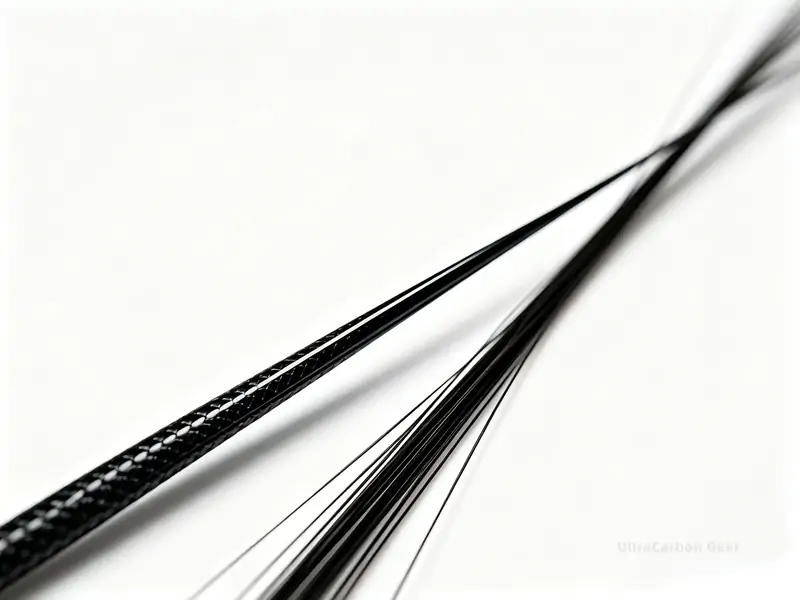
Carbon fiber is a material made almost entirely of pure carbon atoms — over 90% carbon, to be precise. These atoms are bonded together in microscopic crystals that align themselves into long, ultra-thin filaments. We're talking impossibly thin: a single carbon fiber filament measures between 5 and 10 micrometers in diameter. To help you visualize that, it's about one-tenth the thickness of a human hair.
Now here's where it gets magical.
When you bundle thousands of these tiny filaments together — imagine 12,000 of them twisted into a single strand (that's what the industry calls "12K carbon fiber," by the way) — you get something that behaves almost impossibly. It's one-fifth the weight of steel, but five to ten times stronger. A carbon fiber rope just 5mm thick can lift two full-size SUVs off the ground, while weighing no more than a bottle of water.
Let that sink in for a moment.
The secret lies in the molecular structure. During manufacturing, the carbon atoms arrange themselves into hexagonal patterns — microscopic honeycombs, essentially — that look like tiny graphene sheets stacked and aligned along the fiber's length. Think of it as a million invisible steel cables all pulling in exactly the same direction. This is why carbon fiber has what engineers call "anisotropic" properties: it's incredibly strong along the fiber axis, which is exactly how you want strength to work in a bicycle frame or a drone arm.
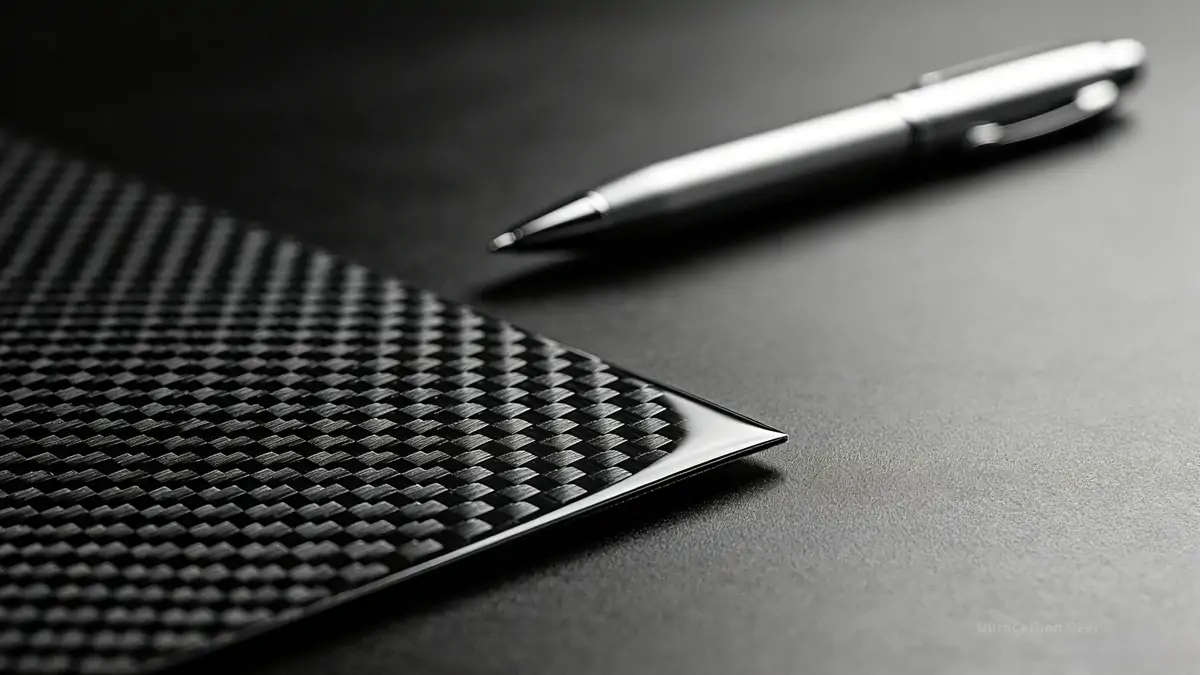
But raw carbon fiber filaments alone aren't what you hold in your hand. Those filaments get embedded in a resin matrix — typically epoxy — to create what's formally called Carbon Fiber Reinforced Polymer (CFRP). The fibers carry the load; the resin holds them in place and transfers forces between them. Together, they create a composite that's greater than the sum of its parts.
Here's a quick comparison to put things in perspective:
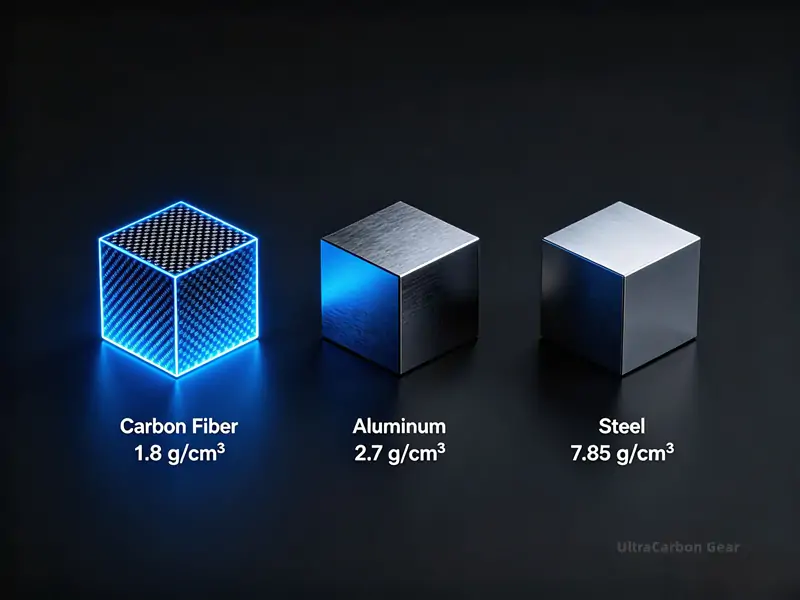
| Material | Density (kg/m³) | Tensile Strength (MPa) | Weight Comparison |
|---|---|---|---|
| Steel | ~7,850 | 400–550 | 5× heavier than CF |
| Aluminum | ~2,700 | 200–310 | ~2.5× heavier than CF |
| Carbon Fiber (PAN-based) | ~1,750–1,950 | 3,500–6,000 | Baseline — the lightweight champion |
What this table doesn't show you is that carbon fiber's specific strength (strength divided by weight) and specific stiffness (stiffness divided by weight) are roughly ten times higher than steel or aluminum. That's the metric that actually matters in the real world — and it's where carbon fiber leaves every traditional metal in the dust.
Chapter 2: How Carbon Fiber Is Made — The Journey from Polymer to "Black Gold"
You might be wondering: if carbon fiber is just carbon atoms, why can't we just scoop it out of the ground? After all, carbon is everywhere.
Well, here's the thing. Creating carbon fiber isn't like mining iron ore. It's more like baking a very precise, very expensive cake — one that requires weeks of preparation and temperatures hot enough to melt most metals.
Step 1: The Precursor — Where It All Begins
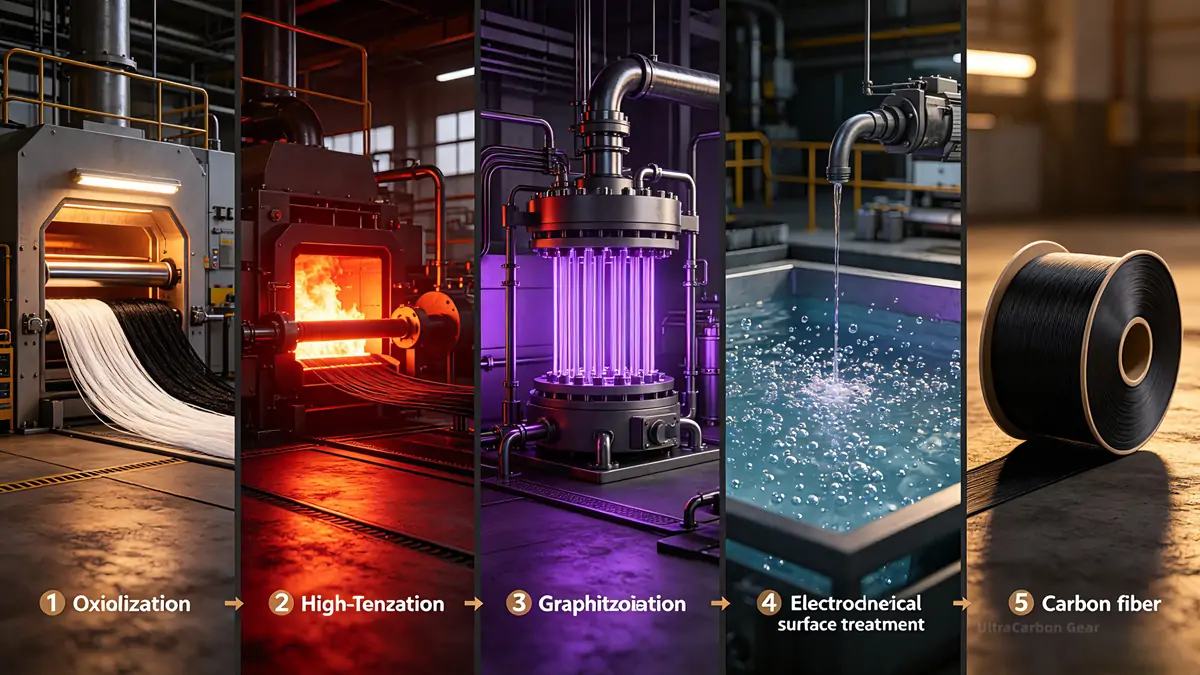
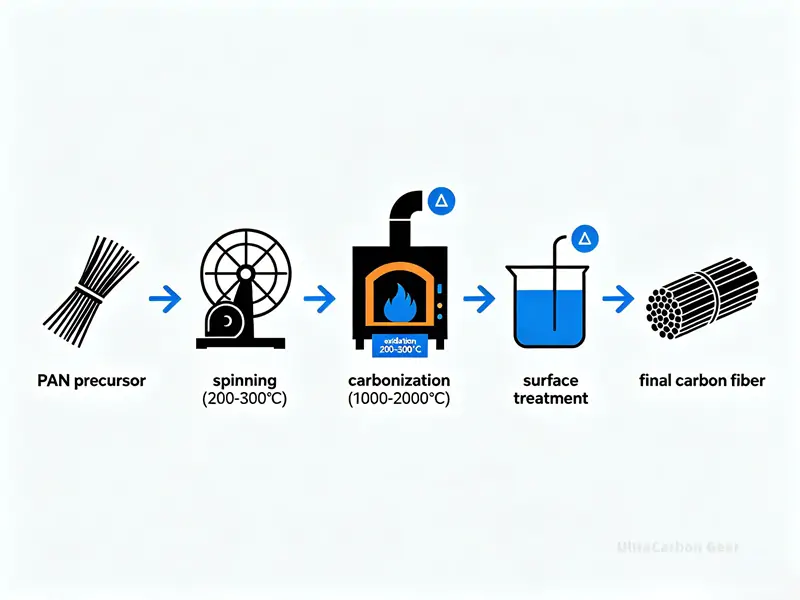
Almost all commercial carbon fiber today starts with a polymer called polyacrylonitrile, or PAN for short. Think of PAN as the dough in our baking analogy. It's a synthetic polymer that, when heated under very specific conditions, transforms into nearly pure carbon while keeping its fibrous shape intact.
Why PAN? Because it has a regular molecular structure and delivers a very high carbon yield — meaning most of it survives the intense heating process instead of burning away. Each manufacturer has its own proprietary PAN recipe, tweaking comonomers and processing conditions to achieve specific final properties. The quality of this precursor is so critical that it accounts for 40–50% of the total production cost of carbon fiber. Get the PAN wrong, and nothing you do downstream can fix it.
Step 2: Spinning — Turning Goo into Threads
The PAN polymer is dissolved into a concentrated solution, then extruded through a spinneret — imagine a showerhead made of precious metal, with thousands of microscopic holes. As the solution emerges, it passes through a coagulation bath where the polymer solidifies into continuous filaments. This process is called wet spinning, and controlling the temperature, concentration, and pulling speed is a dark art that separates great carbon fiber from mediocre.
Step 3: Oxidation — The Slow Transformation
Here's where patience becomes mandatory. The PAN fibers are heated to 200–300°C (about 400–570°F) in air. This step takes hours — you can't rush it. Oxygen molecules latch onto the polymer chains, cross-linking them and converting the thermoplastic PAN into a thermoset structure that won't simply melt when things get really hot later. The fibers change color from white to beige, then brown, then eventually black.
Step 4: Carbonization — Into the Furnace
Now we enter the realm of extreme conditions. The oxidized fibers pass through a furnace filled with inert gas (no oxygen allowed — otherwise they'd simply burn to ash). Temperatures soar to 1,000–2,000°C, depending on the desired final properties. At these hellish temperatures, nearly everything that isn't carbon gets driven off. Hydrogen, nitrogen, oxygen — they all depart as gases, leaving behind fibers that are 95%+ pure carbon. The carbon atoms reorganize into those aligned graphite-like crystals that give carbon fiber its legendary strength.
For ultra-high-modulus fibers, there's sometimes a fourth step: graphitization at 2,500–3,000°C, which further perfects the crystal structure but at enormous energy cost.
Step 5: Surface Treatment and Sizing — The Final Touch
Freshly carbonized fibers don't bond well with resins — their surface is too smooth, too chemically inert. So they pass through an electrolytic bath that etches the surface at the microscopic level, creating ridges and reactive sites. Then a "sizing" coating (a thin layer of specialized polymer) is applied to protect the filaments during handling and to match the chemistry of whatever resin system the end user will employ.
Want to know why this entire process makes carbon fiber expensive? Each step requires precision equipment, massive energy input, and painstaking quality control. A single production line can span the length of a football field. The carbonization furnaces alone consume electricity at staggering rates. And if one variable drifts out of spec — temperature, tension, gas flow — you can lose an entire batch. That's why raw PAN-based carbon fiber historically cost around $11 per kilogram even in bulk, and why finished carbon fiber products command premium prices.
But — and this is where the story gets really interesting — China has been systematically attacking every one of these cost drivers. More on that in Chapter 4.
Chapter 3: What Makes Carbon Fiber Products Worth Your Money
So carbon fiber is scientifically cool. But why should you care when you're shopping? What does it actually deliver that makes a carbon fiber product worth paying more for?
Let me give you five concrete reasons — the kind you can feel in your hands and notice in your daily life.
1. The Weight Difference Is Immediately Shocking
The first time you pick up a carbon fiber product, your brain will short-circuit for a second. I'm not exaggerating. A carbon fiber road bicycle frame weighs just under 700 grams — less than a loaf of bread. An equivalent aluminum frame weighs nearly three times as much. When you're climbing a hill or carrying your bike up apartment stairs, every gram saved is a blessing you can feel.
Car manufacturers have been chasing this dream for decades. Using carbon fiber components instead of steel reduces vehicle weight by 40–50% compared to traditional steel structures, and 20–30% compared to aluminum. For electric vehicles specifically, every 10% of weight shaved off translates to 6–8% more driving range. That's the difference between white-knuckle range anxiety and arriving home with charge to spare.
2. Strength That Defies Common Sense
Remember that 5mm carbon fiber rope lifting two SUVs? That's not marketing fluff — it's what a tensile strength of 3,500–6,000 MPa actually means in the real world. Carbon fiber doesn't just match steel's strength; it dramatically exceeds it while weighing a fraction as much.
But strength isn't just about raw numbers. Carbon fiber also exhibits extraordinary fatigue resistance — it can endure millions of loading cycles without significant degradation. A carbon fiber bicycle frame won't gradually weaken the way an aluminum one does after years of road vibrations and impacts. It simply keeps performing.
3. It Won't Rust, Corrode, or Degrade
Leave steel outside in the rain, and you know what happens. Aluminum fares better but still corrodes, especially in salty environments. Carbon fiber? It laughs at moisture, salt, and most chemicals. This corrosion resistance means products that last — drone frames that survive coastal humidity, fishing rods that endure saltwater splashes, automotive parts that outlast the car they're bolted to.
Carbon fiber also has extremely low thermal expansion — it barely grows or shrinks with temperature changes. That telescope tripod you're considering? It won't shift subtly between a cold night and a warm afternoon, keeping your setup precisely dialed in. For precision applications, this dimensional stability is gold.
4. Vibration Damping — The Hidden Comfort Factor
This is one of those benefits nobody tells you about until you experience it. Carbon fiber has excellent vibration damping properties — it naturally absorbs and dissipates vibrations rather than transmitting them. On a bicycle, this means less road buzz reaching your hands and seat. In a tennis racket, less shock traveling up your arm. In a car, a smoother, quieter ride. It's the difference between finishing a long ride feeling fresh versus feeling like you've been in a paint shaker for four hours.
5. Design Freedom — Curves That Metal Can't Touch
Carbon fiber doesn't come in sheets that need to be stamped or welded. It starts as flexible fabric that can be draped over complex, flowing shapes before curing into rock-solid form. This allows designers to create organic curves and aerodynamic profiles that would be impossible or prohibitively expensive in metal. Look at the sculpted lines of a modern supercar or the elegant arc of a high-end bicycle frame — carbon fiber makes those shapes possible, and the aesthetics are part of what you're paying for.
Here's a quick summary of the key properties and how they benefit you in everyday products:
| Property | What It Means | Where You'll Notice It |
|---|---|---|
| Ultralight density | 1/5 the weight of steel | Bikes, luggage, drone frames |
| Superior specific strength | Stronger than steel per kg | Sports equipment, automotive parts |
| Excellent fatigue resistance | Maintains strength over time | Bike frames, fishing rods, structural components |
| Corrosion-proof | Won't rust or degrade | Outdoor gear, marine products, accessories |
| Minimal thermal expansion | Holds shape in all temps | Precision instruments, tripods, optical equipment |
| Vibration damping | Absorbs shock naturally | Bikes, tennis rackets, automotive components |
| Design flexibility | Complex curves achievable | Premium product aesthetics, aerodynamic shapes |
Now, is carbon fiber the solution to every problem? Of course not. It's relatively expensive (though we'll see how that's changing), it can be brittle under certain types of impact (unlike metal, which dents — carbon fiber can crack without visible warning), and once damaged, it's harder to repair than a steel part. But for applications where weight savings, strength, and longevity matter most, it's in a league of its own.
Chapter 4: China's Carbon Fiber Story — From "Left Behind" to "Global Leader"
Now let me tell you a story that most people outside the industry don't know — and it's honestly remarkable.
Rewind to the early 2000s. Back then, the global carbon fiber market was dominated by a handful of Japanese and American companies: Toray, Teijin, Mitsubishi Chemical, and Hexcel. These giants controlled not just the supply of carbon fiber, but the technology to make it. For decades, carbon fiber was produced at scale in only a few countries, and the know-how was fiercely guarded.
Around 2005, things took a sharp turn. Because high-performance carbon fiber has both civilian and military applications — it's used in everything from commercial airliners to intercontinental missiles — Japan and the United States imposed strict export controls. As one report memorably put it: you could buy a Boeing 787, but you couldn't buy the high-end carbon fiber used to build it.
Let that sink in. China could purchase the finished airplane, but not the raw material that made that airplane possible. It was a strategic chokehold.
Here's the part that gives me chills: at that moment, Chinese researchers at the Shanxi Institute of Coal Chemistry — a research institution in Taiyuan — were summoned to an emergency meeting at the Chinese Academy of Sciences. The question was brutally direct: "Can you produce aerospace-grade carbon fiber for the nation — and can you do it by June 30, 2008?"
They had roughly three years to figure out what had taken Japan's Toray over three decades to commercialize.
The Breakthrough Years
The researchers threw themselves into the challenge. Starting almost from scratch, they reverse-engineered every step of the PAN-to-carbon-fiber process, designed and built production equipment, and endured countless failed batches. By 2008 — against all odds — China became the third country in the world, after Japan and the United States, capable of independently producing aerospace-grade T300 carbon fiber.
(Quick explainer: "T300" is the entry-level aerospace grade in the Toray classification system. The "T" stands for tensile strength; higher numbers mean stronger fiber. T300 started it all; today's cutting edge is T1100 and beyond.)
But T300 was only the beginning. Through successive generations of relentless refinement, Chinese researchers pushed upward through the grades:
- T700 and T800 — now in stable mass production, with dedicated carbonization lines running around the clock.
- T1000 — achieved continuous production verification with an annual capacity of approximately 200 tons, supporting applications from launch vehicles to strategic defense systems.
- T1200 — in March 2026, China globally debuted T1200-grade ultra-high-strength carbon fiber, with tensile strength exceeding 8,000 MPa (roughly 10× that of ordinary steel). This wasn't a laboratory curiosity; it was a product with hundred-ton-scale industrial production capability.
This is the carbon fiber equivalent of going from building a bicycle to launching a spacecraft — except they did it in less than two decades.
The Numbers That Tell the Real Story
The transformation in production scale has been nothing short of staggering:
- In 2010, China's carbon fiber production capacity was essentially negligible — a rounding error on the global stage.
- By 2019–2023, China's capacity exploded, growing nearly fivefold in five years as dozens of new production lines came online.
- By 2022, domestic carbon fiber consumption in China surpassed imports for the first time in history.
- By 2024, the domestic substitution rate exceeded 80% — meaning more than four out of every five carbon fiber products sold in China were made with domestically produced fiber.
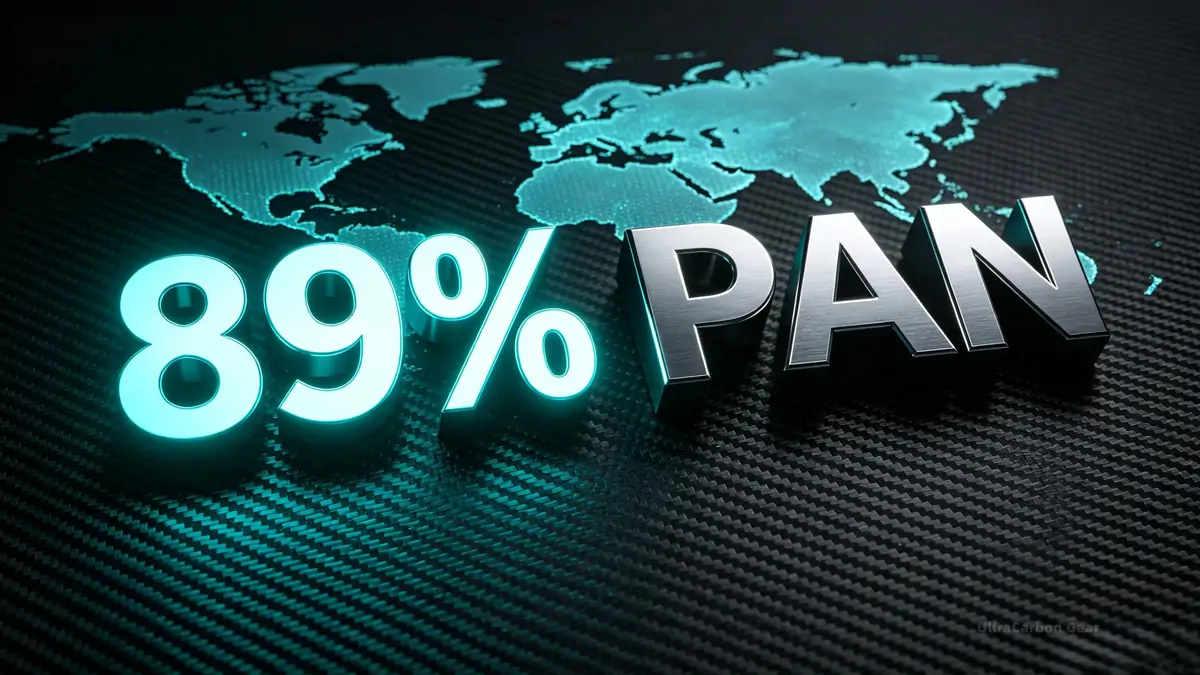
- By 2025, China's carbon fiber production capacity reached approximately 47.7% of the global total — essentially one out of every two tons of carbon fiber produced on Earth came from China.
And here's the headline number: in 2025, Jilin Chemical Fiber Group — a company based in Jilin City in northeast China — achieved annual carbon fiber capacity of 70,000 tons and sales of 56,000 tons, making it the number one carbon fiber producer globally by both production volume and sales.
This isn't just a growth story. It's a complete reshaping of the global competitive landscape. A decade ago, the carbon fiber map was simple: Japan and the U.S. dominated, and everyone else was a customer. Today, the industry speaks of a "three-legged race" between China, Japan, and the United States — and China is running faster than anyone predicted.
Why This Matters for Your Wallet
Here's the part that directly affects you as a consumer.
When a material goes from scarce to abundant, from controlled-by-a-few to produced-by-many, something predictable happens: the price drops. And carbon fiber has done exactly that. T300-grade carbon fiber that once sold for around 200,000 RMB per ton (roughly $28,000) now trades at approximately 60,000 RMB per ton — a 70% price reduction.
Chinese manufacturers achieved this through relentless cost innovation: developing domestic large-tow carbonization equipment, implementing energy recycling systems that cut electricity consumption by about 25%, and scaling production to levels where fixed costs get spread across vastly more units.
The result? Carbon fiber products that were once exclusive to Formula 1 teams and aerospace contractors are now showing up on Amazon, in sporting goods stores, and in your local bike shop. That carbon fiber bicycle that would have cost $5,000 a decade ago? You can now find high-quality models at a fraction of that price — with Chinese-made carbon fiber frames matching the performance of established Western brands at significantly lower cost.
Carbon fiber has gone from being sold "by the kilogram" — with the implication that you'd only buy tiny quantities — to being sold "by the ton" as a genuine industrial commodity. And that shift is directly traceable to China's emergence as the world's dominant producer.
Chapter 5: Where You'll Actually Encounter Carbon Fiber in Everyday Life
Let's move from the macro story to the micro — your daily life. Because the most exciting part of this carbon fiber revolution isn't happening in satellite factories. It's happening in the products you can buy, hold, and use.
Sports and Recreation
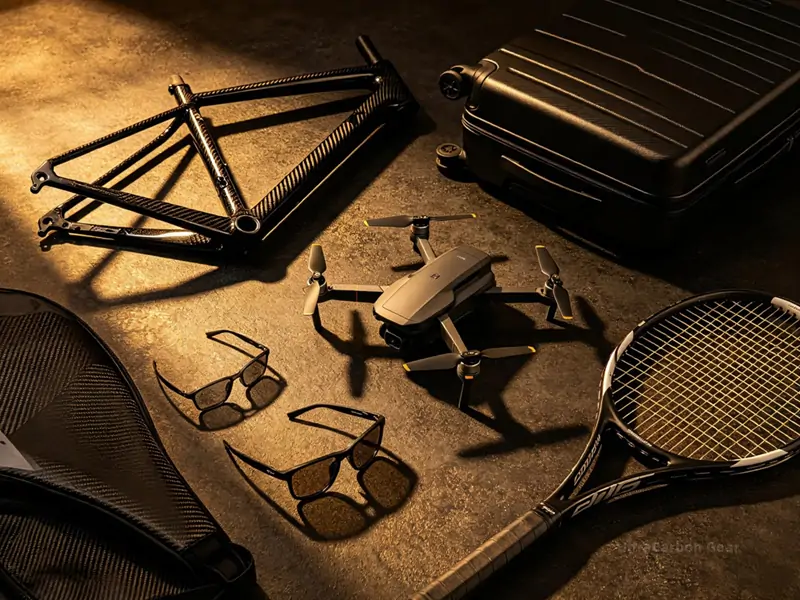
This is where most people first touch carbon fiber. Modern bicycles represent the most visible application — a carbon fiber road bike frame weighing under 700 grams delivers a riding experience that aluminum simply cannot match, particularly on long climbs where every gram of weight fights against you. Tennis rackets made with carbon fiber offer larger sweet spots and better vibration damping than their aluminum predecessors. The same applies to golf club shafts, hockey sticks, ski poles, and fishing rods — all lighter, stronger, and more responsive thanks to carbon fiber reinforcement.
In Jilin City's carbon fiber industry park exhibition center, you can see the full range: carbon fiber glasses frames so light you forget you're wearing them, foldable luggage that weighs almost nothing empty, drone frames that extend flight times through weight savings, and surfboards with exactly the right balance of flex and stiffness. Some companies are even producing carbon fiber furniture — chairs and tables strong enough to hold a person, light enough to lift with one finger, resistant to moisture and warping.
Automotive and Transportation
The automotive industry is where the performance benefits become most dramatic. Carbon fiber in cars isn't just about looking fast — though the woven texture is undeniably beautiful. It delivers genuine engineering advantages: structural parts that cut vehicle weight while increasing crash energy absorption, battery enclosures for EVs that reduce mass while improving thermal management, and suspension components that shave unsprung weight for better handling.
Tesla's use of carbon fiber in the Model S Plaid's rotor sleeve and the 4680 battery's protective shell demonstrates how the material has moved beyond supercar exclusivity into high-volume premium vehicles. Meanwhile, carbon fiber drive shafts, body panels, and interior components are finding their way into increasingly mainstream models.
Aerospace and Wind Energy
Every time you board a modern airliner, you're trusting your life to carbon fiber. The Boeing 787 Dreamliner made history as the first large commercial aircraft with a fuselage and wings built substantially from carbon fiber composites, cutting airframe weight by roughly 20% compared to conventional aluminum construction. That weight saving translates directly into fuel savings, which is why every new aircraft program now specifies extensive carbon fiber content.
On the ground — well, spinning in the air — wind turbine blades represent one of the fastest-growing carbon fiber applications. Longer blades capture more wind energy, but they also get heavier — which creates a vicious cycle. Carbon fiber breaks that cycle by enabling blades that are simultaneously longer, stiffer, and lighter. In 2025 alone, global wind energy demand for carbon fiber reached approximately 100,000 tons, with Chinese wind turbine manufacturers accounting for about 40,000 tons of that demand after years of small-scale testing and validation.
Chapter 6: A Word About Quality — How to Choose the Right Carbon Fiber Product
After everything I've told you about China's production leadership and falling prices, you might be wondering: does cheaper mean worse? Is carbon fiber from Chinese manufacturers as good as the Japanese stuff that built the 787?
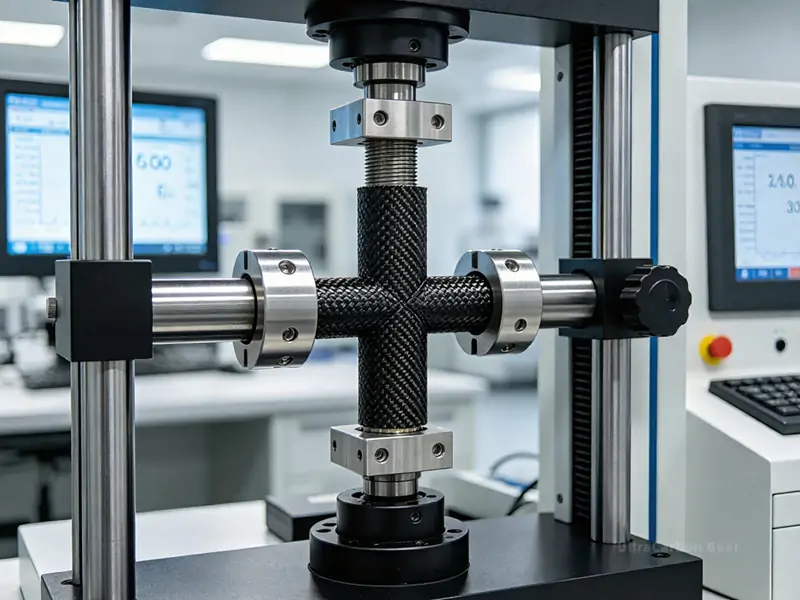
This is a fair question, and the honest answer is: it depends on the grade, the manufacturer, and the application.
For consumer products — bicycles, sporting goods, luggage, accessories — Chinese-made carbon fiber has reached performance levels that are indistinguishable from Japanese or American equivalents for the vast majority of users. The T700 and T800 grades coming out of modern Chinese production lines meet rigorous specifications and undergo the same types of quality testing. Companies like Zhongfu Shenying (中复神鹰) have established themselves as globally competitive producers, with products that rival Toray's in performance metrics.
But I want to be straight with you: for the absolute bleeding edge — the carbon fiber that goes into primary aerospace structures on next-generation aircraft, or the ultra-high-modulus fibers used in satellites — Japanese and American producers still hold advantages in consistency, traceability, and decades of certification data. Closing that gap is the next frontier.
For you as a consumer, the takeaway is this: the carbon fiber in a quality product from a reputable brand will perform beautifully, regardless of which country produced the raw fiber. What matters far more is the design, the manufacturing quality, and the brand's commitment to testing and quality control. A well-made carbon fiber product from a conscientious manufacturer will last for years and deliver exactly the lightweight, responsive performance that makes carbon fiber special.
When shopping, look for:
- Clear specifications about what grade of carbon fiber is used (T700, T800, etc.)
- Transparent manufacturing details — is it prepreg layup? Forged composite? Filament winding?
- Warranty and support — reputable brands stand behind their carbon fiber products
- Reviews from actual users — carbon fiber's advantages should show up in real-world feedback
Chapter 7: Why This Material Makes Products Better — and Why You'll Feel the Difference
Here's where I get personal with you.
The first time I held a truly lightweight carbon fiber product — I mean really held it, picked it up expecting heft and finding almost nothing — I laughed out loud. It felt like a magic trick. My brain had been conditioned over a lifetime to associate "strong" with "heavy," and here was an object that shattered that assumption completely.
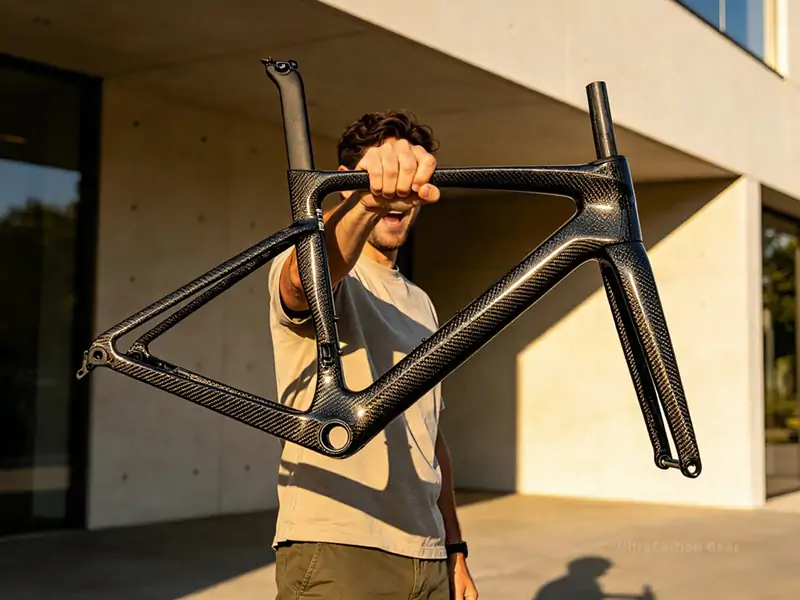
That moment of surprise never really gets old. Every time you pick up a carbon fiber bicycle and carry it up a flight of stairs without breaking a sweat. Every time you swing a carbon fiber tennis racket and feel the ball respond with a satisfying pop rather than a jarring clang. Every time you pack a carbon fiber suitcase and realize you can actually lift it into the overhead bin without straining your shoulder.
This is not just about specs and numbers. It's about how products feel in your hands, how they perform when you use them, and how they last through years of faithful service.
And the best part? Thanks to the transformation of the global carbon fiber industry — a transformation in which China has played the starring role — this experience is no longer reserved for the wealthy few. Carbon fiber has come down to earth. It's accessible. It's practical. And it's waiting for you to discover it.
Your Next Step
Every great product starts with a great material. Carbon fiber isn't just another synthetic fiber or composite — it's the defining material of lightweight performance, and it's more available today than at any point in history. The engineering is fascinating. The story of China's rise from zero to global leader is genuinely inspiring. But what matters most is what carbon fiber can do for you: products that are lighter to carry, stronger under stress, more comfortable to use, and built to outlast their conventional counterparts.
Browse our collection of carbon fiber products — whether you're looking for that perfect road bike, a set of luggage that won't weigh you down, or accessories that combine elegance with indestructible performance. Every piece is crafted with the same material that flies through the sky at 500 miles per hour and spins on wind turbines 100 meters above the ocean. Now it's ready for your next adventure.
Welcome to the carbon fiber revolution. Your lighter, stronger, better-performing life starts here.